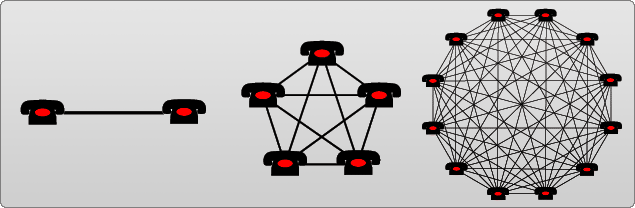
Collective Action You are probably familiar with the prisoner’s dilemma. For those who don’t know, here’s a quick summation. The prisoner’s dilemma is the archetypical game theory situation. See the above example. If both players confess, both loose 6 points of utility. If neither confess, both loose one point of utility. But if one confesses, … Continue reading What is Social Capital?
Author: epiphanyaweek
Free Speech, Social Media, and Network Externalities
At risk of seeming condescending, many arguments about free speech are cringe-worthy bad, such as the common refrain, “Freedom of speech doesn’t mean freedom from consequences!” The Soviets could claim the same thing. “We let you say what you want, but the consequence is being sent to the gulag. Freedom of speech doesn’t mean freedom … Continue reading Free Speech, Social Media, and Network Externalities
Third Order Thinking (Or: Is a Whale a Fish?)
Between 1:53:30 and 1:55:30, physicist and economist Eric Weinstein (to the right of his brother, Bret Weinstein, who I have a whole post about), asks a simple question: “Is a whale a fish?” You might read that and think I’m an idiot. A whale isn’t a fish; a whale is a mammal. But let us step … Continue reading Third Order Thinking (Or: Is a Whale a Fish?)
Traditions and Junk DNA
Have you ever wondered why there is still a royal family in the UK? One that doesn’t ostensibly holds no power, and “rules” over (several) otherwise democratic countries? Have you ever wondered about seemingly arbitrary cultural practices, like marriage? Why businessmen wear a suit and tie? These things seem normal because they are the way … Continue reading Traditions and Junk DNA
Legitimate criticisms of industrialization
I unequivocally believe that the industrial revolution was a good thing. It improved our quality of life in an uncountable number of ways we take for granted. Modern medicine, modern media, modern transportation. Everything modern is a product of the industrial revolution. However, nothing is perfect; economist Thomas Sowell points out that in economics there … Continue reading Legitimate criticisms of industrialization
Why do we play games?
In decision theory, the term "game" has a specific definition that is different from everyday use. Because this blog is based on decision theory, it is worth nodding to that fact. However, that is not the subject of this post. This post is about the term “game” in common usage. I would like to both … Continue reading Why do we play games?
Zip Ties and Ear Plugs
A zip tie starts in an opened position. Then you connect the two ends. A zip tie can always tighten; it will never loosen. If you want a zip tie to be loose, you will have to take special care to ensure that it never tightens. You can not fix the situation after it tightens. … Continue reading Zip Ties and Ear Plugs
The errors with Bret Weinstein’s four-part test of adaption
A biologist I admire, Bret Weinstein, employs a four-part test to determine whether a trait is the product of evolution. https://www.youtube.com/watch?v=DtdOhBoZfNg Is it complex? Does it have a cost? Is there variation in the amount of cost that is spent? Does it persist over evolutionary time? If a trait has all of those characteristics, then … Continue reading The errors with Bret Weinstein’s four-part test of adaption
If we design strong AI, it might not take over the world. It might just sit around masturbating.
The arguments of this article have been re-written here in section 3.
Land, Status, People
Google defines "zero sum": (of a game or situation) in which whatever is gained by one side is lost by the other. Ask yourself, what gives something that property? I posit, it is something that one cannot create. Can only be taken. When it is impossible to create something, the only way to attain it is … Continue reading Land, Status, People